 English
 日本語
 한국어
 العربية
 Deutsch
 ไทย
 Français
 Español
 Português
 Italiano
 Bahasa Indonesia
 中文
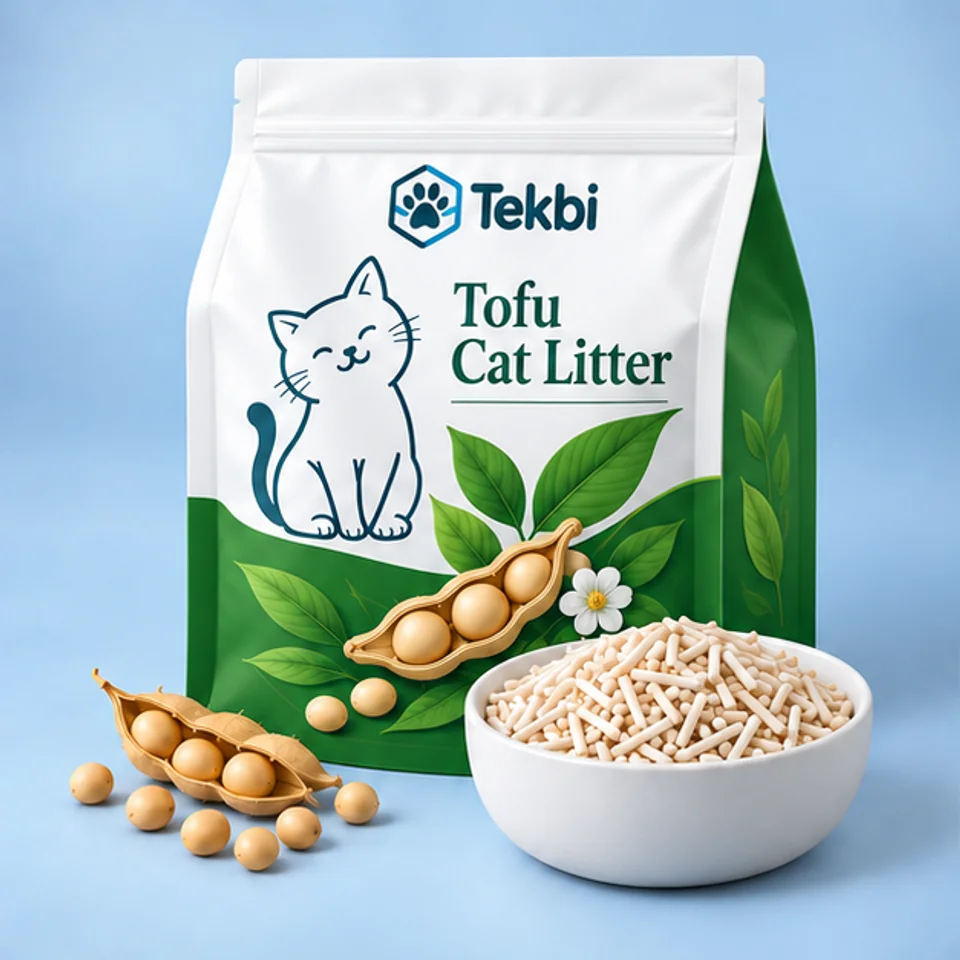
TEKBI
Tofu Cat Litter
Tofu Cat Litter. Ingredients: Pea fiber + Corn starch. For pet brands, importers and distributors. Discuss samples and private-label packaging.
Product performance
- Clumping
- ★★★★★
- Absorption
- ★★★★★
- Base adhesion
- Minimal sticking
- Odor control
- Good
- Dust control
- Low dust
Supplier comparison for product selection, not customer review scores or a laboratory test report. Performance depends on formulation, batch and test conditions.
Automatic litter box compatibility
Confirm particle size, sieve openings and the cleaning cycle with samples in the specific device.
Materials & catalogue specifications
- Ingredients
- Pea fiber + Corn starch
- Particle size
- 1.5-2.0 mm
- Nominal hardness
- ~50 N
Catalogue specifications supplied by Tekbi. Confirm the selected formulation, grade and batch before ordering; agree test conditions and supporting documents for performance claims.
Download the English company & product catalogue (PDF, 3.7 MB) ↗Product introduction
Designed for modern cat-owning households, this plant-based litter does more than absorb liquid: it quickly captures moisture and forms firm, easy-to-scoop clumps. By enclosing waste and reducing residual moisture in the tray, it helps limit odor spread and keeps the surrounding space fresh. Balanced overall performance helps brands develop a quality product centered on rapid clumping, low dust and lasting odor control.
Product features
- Rapid absorption & odor-locking clumps: Plant-based tofu fibers quickly absorb liquid and form firm clumps, enclosing waste before moisture and odors spread through the tray.
- Moisture management & odor control: Strong absorption reduces free moisture, helping inhibit bacterial growth and ammonia odor formation at the source.
- Lasting freshness: Helps prevent stale, damp and musty odors from accumulating during daily use, keeping the tray clean and fresh.
Product advantages
- Easier cleaning: Firm clumps help avoid removing clean litter during scooping, simplifying daily care.
- Longer service life: Strong absorption extends the interval between full tray changes and reduces overall litter consumption.
- Low-dust comfort: Plant-based pellets generate less airborne dust than conventional mineral litter.
- A fresher home: Suited to households with high expectations for odor control and fresh indoor air.
- Lightweight handling: Compared with conventional mineral litter, it is easier to carry, pour, store and transport.
Product limitations
- Higher price: Quality plant-based materials and refined processing generally cost more than standard bentonite litter.
- Moisture sensitivity: Store tofu litter in a dry environment. Prolonged exposure to humid air can soften pellets and reduce clumping performance.
OEM/ODM & production capabilities
- Custom formulations: Adjust clumping speed, absorption, deodorizing additives, fragrance, pellet color and diameter for different market needs.
- Batch traceability: Each bag carries the production date, production time period and batch number to support traceability and quality control.
- Low-dust process control: Monitor raw-material selection, extrusion, drying and dust removal to maintain consistent pellet hardness and low-dust standards.
- Precision pellet formation: Controlled extrusion produces uniform pellets with consistent diameter, density and absorption performance.
- Custom packaging: Private-label bags, color-printed cartons and multiple pack sizes, with multilingual labels for retail, wholesale and ecommerce channels.
- Production-line quality control: Experienced technicians oversee moisture content, pellet integrity, clumping performance and dust levels under rigorous inspection standards.
Packaging & private label
Discuss flat-bottom zipper bags, vacuum packs or handled stand-up pouches. Confirm film, seal, fill weight, artwork and transport requirements for your market.
Please include your target market, preferred particle size, fragrance requirements, packaging and expected quantity. Formula, specifications, availability and commercial terms are confirmed per project.
Discuss specifications & samples ↑Procurement questions
How are MOQ and lead time confirmed?
Formulation, packaging, minimum order quantity and delivery feasibility are confirmed after reviewing your project.
How are samples evaluated?
Discuss sample availability and compare performance using agreed methods.
Which product specifications should we discuss?
Confirm material composition, particle size and quality requirements.
What packaging information should I provide?
Review your logo, pack size, artwork and export packaging needs.