
 English
 日本語
 한국어
 العربية
 Deutsch
 ไทย
 Français
 Español
 Português
 Italiano
 Bahasa Indonesia
 中文
Evaluating Flushable Cat Litter for Japan: Water Dispersion, Clumping Hardness and Vacuum Packaging
A procurement checklist for Japanese OEM buyers: define repeatable dispersion and clump tests, verify disposal instructions, and assess vacuum-bag integrity before making claims.
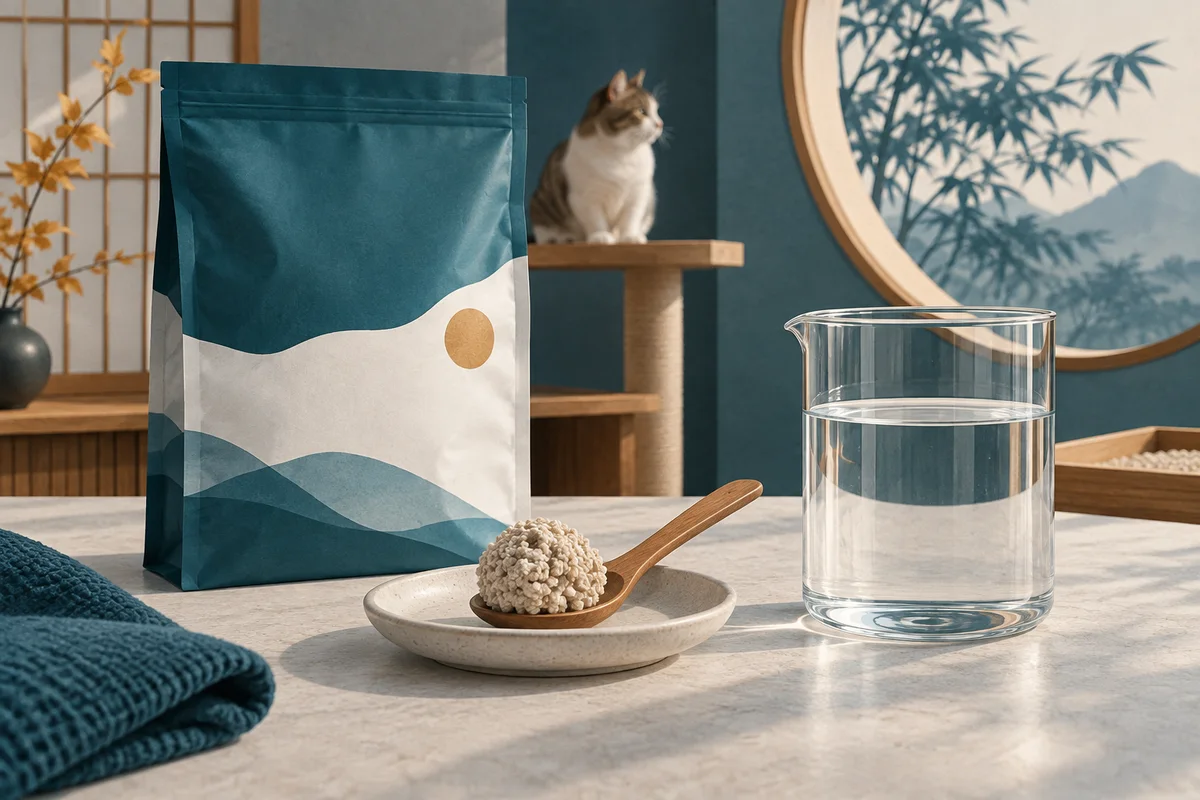
The buying question: convenient care without unsupported promises
For a brand serving compact indoor homes in Japan, litter-box odor, storage space and disposal instructions are useful starting points for a product brief. Buyers seeking flushable tofu cat litter wholesale should evaluate these needs separately rather than treating “flushable” as a complete quality specification. There is no evidence presented here that Japan has the world’s highest requirements.
This article proposes a purchasing evaluation framework, not an official Japanese technical standard or a Tekbi test report. A nominal 1.5 mm pea-fiber formula, 5–10 second dispersion target, nine-layer co-extruded bag, 30-minute low-pressure exposure and leakage target below 0.3% are candidate requirements to investigate. None is a verified Tekbi product specification or performance result.
Start with disposal guidance, before a flushability claim
LIXIL identifies pet litter as a possible cause of toilet blockage. A bag label or a demonstration in a bowl of water cannot establish compatibility with every toilet, drain or building. Confirm the relevant toilet manufacturer’s instructions, building requirements and local disposal guidance for the intended market. Where those instructions prohibit litter disposal through the toilet, a laboratory dispersion result does not override them.
A buyer should request a written disposal statement for the exact formula and have its proposed Japanese wording reviewed before printing. Do not infer flushability from a plant-based ingredient, a small pellet diameter or a fast breakdown video. This guide does not recommend flushing litter or promise to eliminate blockage risk.
Water dispersion is not the same as dissolution
A pellet or clump breaking into small particles is a dispersion or disintegration observation. It does not by itself prove complete dissolution, hydrolysis, emulsification, biodegradation or passage through a drainage system. When evaluating “rapid water dissolution cat litter,” ask the supplier which endpoint was actually measured.
For a proposed 1.5 mm pea-fiber product, first document the actual composition and particle-size range. Test loose pellets and formed clumps separately. Record sample mass, clump age, liquid used to form the clump, water volume and temperature, vessel dimensions, agitation or flow, and the timing start point. Agree an observable endpoint, such as retained material after a defined screening procedure, rather than simply saying the sample has disappeared.
If the purchasing brief proposes 5–10 seconds, identify that interval as an unvalidated target until repeat measurements support it under disclosed conditions. Record remaining solids, repeat count and variability. A test using a large volume of rapidly stirred water should not be presented as proof of performance in a low-flow toilet. Have a qualified laboratory help design any separate drainage-compatibility assessment; do not experiment in occupied building plumbing.
Measure clump handling alongside dispersion
The practical objective is a clump that can be removed with a scoop under the intended use conditions, together with whatever dispersion behavior the agreed specification requires. “The hardest clump” is not a complete purchasing criterion. Define litter depth, liquid dose, waiting time, scoop or loading method and the way breakage is measured.
Compare samples under the same procedure and retain the individual results. Repeat the comparison at relevant clump ages and after the proposed storage conditions. Review handling strength and dispersion results together before selecting a formulation. Do not assume a 1.5 mm nominal diameter or pea-fiber ingredient guarantees either outcome. Record dust, tracking and residue observations separately so they do not get hidden behind a single strength score.
Include odor control in the sample brief
Ask what the odor claim means: a sensory rating, measurement of a specified gas, or another documented method. Define the dose, test duration, temperature, litter quantity and reference sample before comparing results. Fragrance preference should be considered separately from evidence of odor removal.
Use the approved method to compare the actual formulations under consideration. Do not transfer a result for one ingredient to a finished product with a different recipe. Pair any supported product claim with clear routine cleaning and storage instructions rather than implying that litter removes the need for maintenance.
Specify vacuum packaging by evidence, not layer count alone
For a low leakage vacuum bag cat litter brief, ask the packaging supplier to identify the film structure, total thickness, barrier specifications and test conditions, seal configuration, and compatibility with the filled product. Nine-layer co-extruded film can be a proposed construction for evaluation; this article does not establish that Tekbi currently uses it or that nine layers guarantee a lower failure rate.
Approve filled bags, not only film samples. Agree checks for seal integrity, punctures, loss of vacuum and appearance at defined inspection times. Distinguish a temporary change under reduced external pressure from a persistent loss of vacuum after conditions recover. Investigate the cause of an affected bag before assigning every appearance change to a leaking seal.
Make the low-pressure test and leakage target measurable
ASTM D6653/D6653M describes evaluating the effects of high altitude on packaging systems using a vacuum method. Its public scope describes qualitative results. Referencing that method does not prove that a product has passed it, and a pressure-exposure test is not a guarantee of a shipment-wide leakage rate.
A proposed 30-minute exposure needs a defined pressure, ramp and recovery profile, conditioning, sample count, filled-pack configuration and inspection criteria. Ask a competent laboratory to select conditions appropriate to the transport route and identify the method edition used. Do not describe an arbitrary duration alone as standards compliance.
If the commercial target is below 0.3% leakage, define the denominator, inspection stage, observation period, defect definition and sampling plan. A few intact bags cannot substantiate that rate. Require an appropriate statistical plan and traceable batch or shipment records before making a numerical claim. Record laboratory performance and actual shipment defects separately.
Supplier checklist and next step for Japanese OEM brands
A search for a “Japan standard pet supplies manufacturer” should lead to specific questions: which requirement, which product, which test method and which supporting record? A phrase on a website is not a certification. Request the formula reference, sample identity, test conditions, disposal wording, packaging specification, traceability and change-control arrangements.
Tekbi understands the importance of reducing customer complaints for Japanese OEM brands. Share your target market, material preference, pack size, vacuum-packaging needs and proposed acceptance criteria. We can discuss the project brief and the evidence needed before agreeing specifications. Sample availability, packaging construction, testing scope and commercial terms require confirmation. Zero complaints, zero blockage and a fixed leakage rate are not promised.
Frequently asked questions
Does dispersion within 5–10 seconds prove flushability? No. It describes only the measured endpoint under the disclosed test conditions; disposal guidance and system compatibility remain separate questions.
Does a nine-layer bag guarantee less than 0.3% leakage? No. Film structure alone is insufficient, and a numerical rate requires an agreed definition and supporting data.
Are these Tekbi test results? No. The dimensions, times, film structure and leakage figure discussed here are proposed procurement criteria awaiting product-specific validation.