 English
 日本語
 한국어
 العربية
 Deutsch
 ไทย
 Français
 Español
 Português
 Italiano
 Bahasa Indonesia
 中文
TEKBI
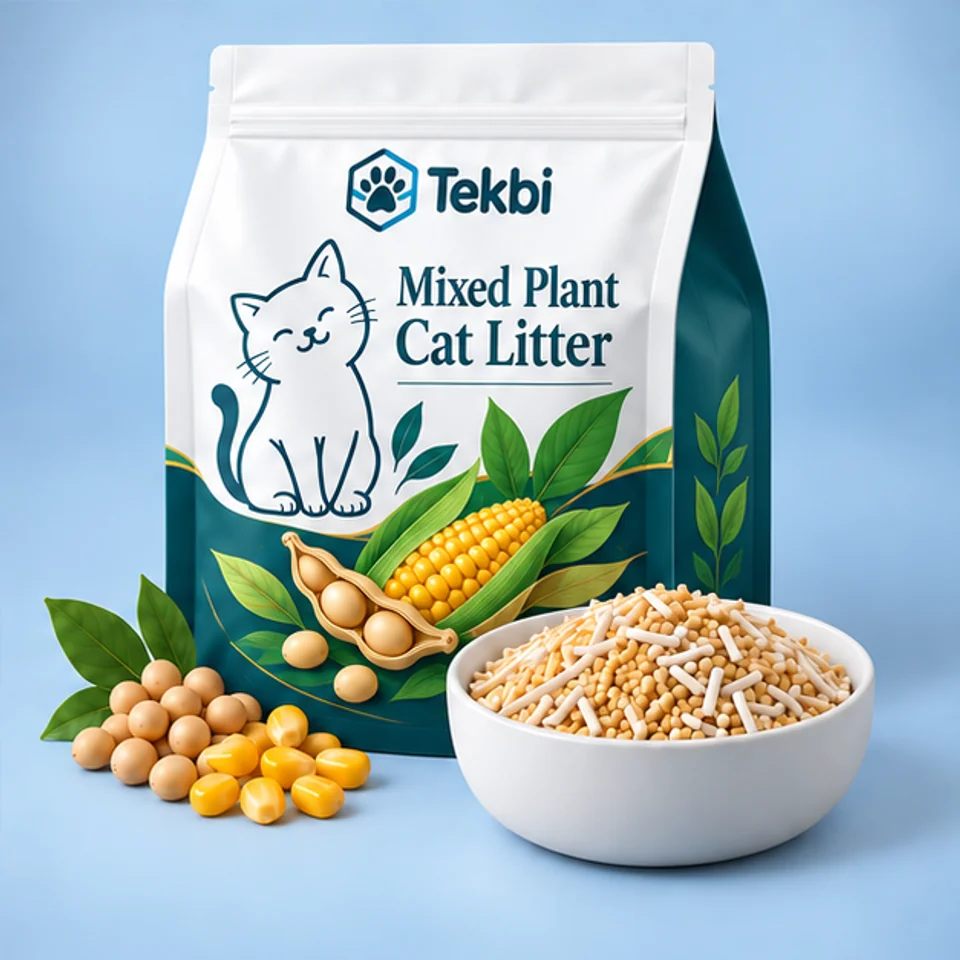
Mixed Plant-Based Cat Litter
Mixed Plant-Based Cat Litter. Ingredients: Cassava starch + Green bamboo fiber + Pea fiber. Blend ratios and particle specifications can be adjusted to customer preferences.
Product performance
Performance is provided for the selected blend and proportions. Please inquire about your specification.
Supplier comparison for product selection, not customer review scores or a laboratory test report. Performance depends on formulation, batch and test conditions.
Automatic litter box compatibility
Confirm particle size, sieve openings and the cleaning cycle with samples in the specific device.
Materials & catalogue specifications
- Ingredients
- Cassava starch + Green bamboo fiber + Pea fiber
- Particle size
- Blend ratios and particle specifications can be adjusted to customer preferences.
Catalogue specifications supplied by Tekbi. Confirm the selected formulation, grade and batch before ordering; agree test conditions and supporting documents for performance claims.
Download the English company & product catalogue (PDF, 3.7 MB) ↗Product introduction
This blend combines cassava, bamboo-fiber and tofu cat litter in one formula for households and brands seeking a balance of clumping, absorption, odor management and easy cleaning. Formula development brings together the flow and clumping characteristics of cassava granules, the absorption and adsorption characteristics of bamboo fiber, and the liquid absorption and encapsulation characteristics of tofu-based plant fibers. Blend proportions and granule specifications can be adjusted to suit market preferences and brand positioning. A clear brand proposition is three complementary plant materials with a customizable performance balance. Final performance is confirmed through sample evaluation.
Product features
- Three plant-based litters: cassava, bamboo fiber and tofu, with proportions adjustable to the product positioning.
- Absorption and clumping balance: material ratios, granule sizes and hardness are coordinated to balance absorption speed, clump integrity and scooping.
- Odor and dust management: formulation and processing address residual moisture, odors, loose fines and granule durability.
Product advantages
- Balanced selection: for brands balancing clumping, odor control, paw feel and usage cost.
- Product differentiation: a clear three-material formulation story and tailored granule combination.
- Flexible development: define the blend around the target market, consumer habits and packaging positioning.
Product limitations
- Ratio-dependent performance: proportions and particle sizes affect clump strength, dust, tracking and consumption; compare samples first.
- Storage and compatibility: store sealed in a cool, dry place. Automatic-box compatibility and flushing must follow final specifications, packaging instructions and local requirements.
OEM/ODM manufacturing strengths
- Formula customization: adjust cassava, bamboo-fiber and tofu proportions and specify whether ratios are by weight or volume.
- Granules and appearance: discuss size, shape, hardness, fragrance and color to balance paw feel, sieving and transport needs.
- Quality and traceability: agree checks for blend uniformity, moisture, absorption, clumping, dust and odors, with batch traceability.
- Packaging: private-label bags, cartons, multiple fill sizes and multilingual labels; quantities and lead times confirmed per project.
Packaging & private label
Discuss flat-bottom zipper bags, vacuum packs or handled stand-up pouches. Confirm film, seal, fill weight, artwork and transport requirements for your market.
Please include your target market, preferred particle size, fragrance requirements, packaging and expected quantity. Formula, specifications, availability and commercial terms are confirmed per project.
Discuss specifications & samples ↑Procurement questions
How are MOQ and lead time confirmed?
Formulation, packaging, minimum order quantity and delivery feasibility are confirmed after reviewing your project.
How are samples evaluated?
Discuss sample availability and compare performance using agreed methods.
Which product specifications should we discuss?
Confirm material composition, particle size and quality requirements.
What packaging information should I provide?
Review your logo, pack size, artwork and export packaging needs.