 English
 日本語
 한국어
 العربية
 Deutsch
 ไทย
 Français
 Español
 Português
 Italiano
 Bahasa Indonesia
 中文
7:3 Mixed Cat Litter for Korea: Evaluating Ammonia Control, Clumping and Private-Label Potential
How Korean buyers can assess a pea-tofu and bentonite blend, verify odor claims, and plan an evidence-led launch for apartment households.
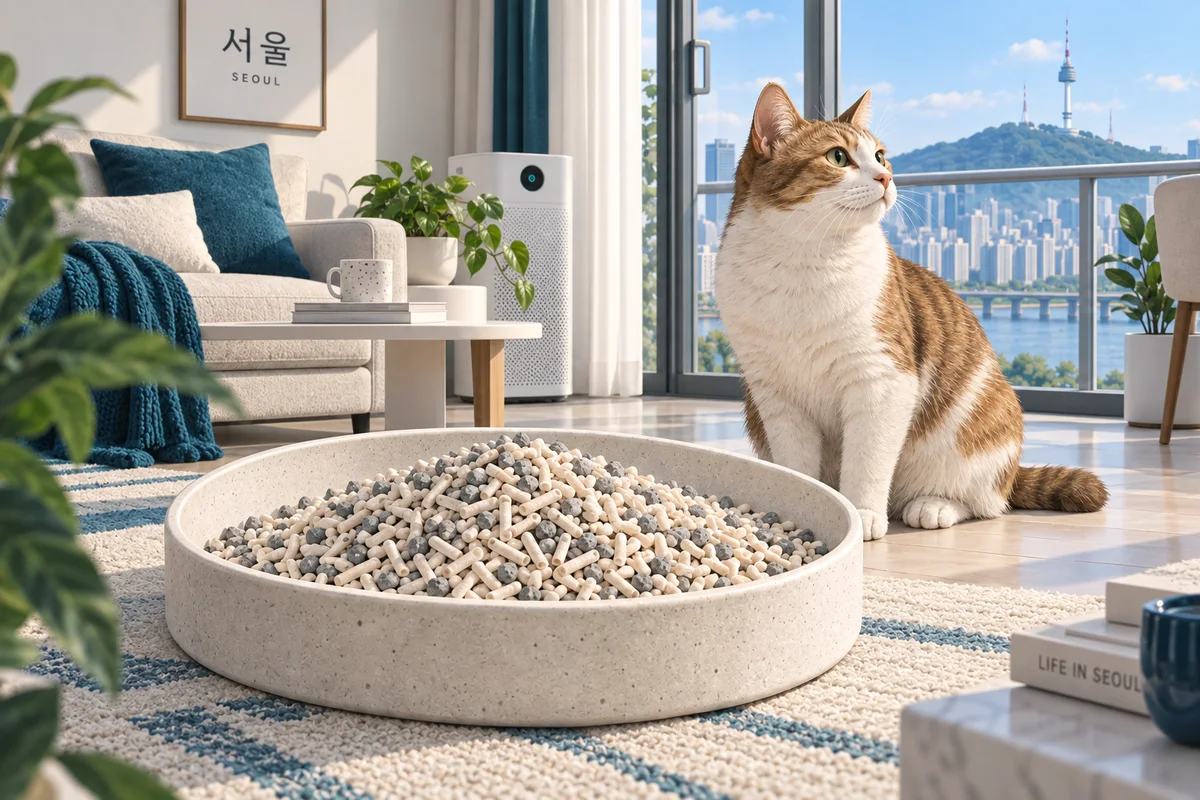
Korean apartment households: start with a defined customer need
Korea’s 2024 population and housing census reported that one-person households represented 36.1% of general households nationwide and 39.9% in Seoul. This provides context for a product brief focused on convenient storage and everyday cleaning. It does not establish cat ownership, preference for mixed litter, or the disappearance of conventional bentonite products.
For a Korean pet brand, useful questions include how customers store an opened bag, remove clumps, manage tracking and describe litter-box odor. Validate those needs through customer interviews, review analysis and a controlled product trial. Do not assume every apartment household wants the same formula.
This guide evaluates a proposed 70:30 blend of pea-tofu litter and a bentonite component incorporating activated carbon. It is a purchasing framework, not a tested Tekbi recipe, a performance guarantee or a claim that this blend leads the Korean market.
Define exactly what 7:3 means
When contacting a 7:3 mixed cat litter supplier, state whether the ratio is measured by mass or volume. Identify whether it refers to finished tofu pellets and a finished mineral blend, or to individual raw ingredients. If activated carbon is added separately, specify whether it is included within the 30% portion or changes the overall proportions. Without this information, two samples labeled 7:3 may not be comparable.
Request the composition, particle-size distributions, moisture specification, fragrance status and batch identification. A proposed 1.5 mm tofu pellet dimension also needs tolerances and a measurement method. Confirm the source of each material through supplier documentation; do not describe bentonite as US-origin without traceable evidence.
Treat 70:30 as one formulation to evaluate against agreed alternatives. It is not an established universal golden ratio. An ingredient list alone cannot demonstrate faster absorption, less dust or a better customer experience.
Test clumping, tray release and tracking separately
For a premium tofu bentonite blend for Korea, compare the candidate against a relevant reference using the same litter depth, liquid dose, waiting time and scoop procedure. Record clump recovery, breakage, material left in the tray and the amount of unused litter discarded with each scoop. Define what an acceptable result looks like before reviewing the samples.
If tray release is a priority, use a consistent tray material and surface condition and record residue after removal. Assess dust under a defined pouring or handling procedure, rather than calling the product dust-free because one video looks clean. Tracking requires its own agreed observation method and conditions; particle dimensions alone do not prove low tracking.
Repeat checks across representative batches and after relevant storage and transport conditioning. Keep observations tied to sample identifiers so that a good result can be linked to the specification eventually ordered.
Activated carbon: ask which odor the evidence measures
A claim about ammonia odor control cat litter should identify the substance measured and the actual finished formulation tested. USDA research on cedar-based litter and biochar discusses capturing MMB, an odor compound in cat urine. That is a different formulation and endpoint from ammonia removal in a pea-tofu and bentonite blend.
Separate USDA research on gaseous ammonia adsorption examined different biochars and treatment conditions in laboratory columns. It supports asking detailed questions about the adsorbent and method; it does not validate this proposed 7:3 litter or show that any activated carbon guarantees a particular ammonia reduction.
Ask a competent laboratory to define an appropriate comparison: sample quantity, exposure, temperature, humidity, measurement times, reference material, repeat count and analytical method. Report results with their test conditions. Keep fragrance preference, sensory odor ratings and measured ammonia concentrations separate. Avoid “five-times odor locking” or a percentage reduction unless the actual product and comparison support it.
Disposal and household use belong in the specification
Do not transfer a flushability statement from the tofu component to the mixed product. A plant-based fraction does not establish that a clay-containing blend is suitable for a toilet or drainage system. Prepare disposal instructions for the exact formula and destination, and have the Korean importer check the applicable local requirements before printing.
The product brief should also include clear storage and cleaning instructions. Neither an adsorbent ingredient nor a favorable laboratory result removes the need for routine litter-box care. Ask trial participants about ease of scooping, dust observations, fragrance acceptance and package handling without suggesting that a particular answer is expected.
Coupang and Naver: validate the offer before promising ROAS
For a brand planning to sell through Coupang or Naver, a proposed formula is a testable offer, not proof of the highest conversion or retention. Build the product page around verified composition, pack size, clear usage information and supported comparisons. Use Korean copy reviewed for accuracy and avoid implying platform endorsement.
Design a pilot with a defined audience, price, promotion, time window and attribution approach. Track conversion, advertising cost, returns, packaging complaints and repeat purchases by cohort. Keep stock availability and major promotional changes in the record so that they can be considered when interpreting results.
Calculate return on ad spend consistently as attributed revenue divided by advertising spend, while reviewing contribution after product, fulfillment, platform and return costs separately. Higher reported ROAS does not necessarily mean higher profit. No evidence supplied here establishes that a 7:3 blend will outperform another formula or free a brand from price competition.
Private-label packaging and order feasibility
Buyers searching for a Coupang private label cat litter manufacturer should verify who makes the product, who supplies the packaging and who is responsible for quality records. A supplier’s website phrase is not evidence of factory ownership or production capacity. Ask for a clear project scope and the documents available for the actual product.
Prepare a Korean packaging brief covering product name, verified composition, fill quantity, storage and disposal wording, lot coding, barcode and importer information as applicable. Confirm the final label requirements with the responsible local partner. Review filled bag samples and shipping-carton requirements before artwork approval.
Ask separately about the minimum quantity for the formulation, bag format and printed design. Small orders and rapid customization depend on availability and project requirements; confirm the MOQ, sample schedule, production lead time and costs in writing rather than assuming a standard promise.
Talk to Tekbi about a Korean-market sample brief
Send your proposed ratio and its measurement basis, material preferences, performance priorities, target pack size, intended sales channel and estimated order quantity. Include the reference product and test methods you want to use, together with Korean packaging requirements already identified.
Tekbi can discuss the brief, potential product and packaging options, and what must be confirmed before progressing. The next useful step is an agreed specification followed by sample evaluation. The proposed 7:3 formula, activated-carbon component, origin of materials, customization scope and delivery schedule all require confirmation; this article does not present them as existing verified capabilities.
Frequently asked questions
Is 70% tofu plus 30% clay always the best blend? No. Compare defined formulations under the same evaluation method and select against your actual customer and commercial requirements.
Does activated carbon prove ammonia removal? No. Request results for the actual finished litter and the stated odor endpoint.
Can this mixture be flushed because most of it is tofu litter? Do not make that assumption. The finished formula and destination disposal instructions must be assessed separately.
Will this product improve marketplace ROAS? That requires a controlled commercial trial. No conversion, repeat-purchase or profit improvement is guaranteed.